

1. Definition of Gearbox
It is a speed converter using gears and an instrumental device to reduce the rpm of motor into the required rpm and get a bigger torque.
2. Features of DKM Gearbox
Small type having a big transfer capability
Good durability
Wide range of gear ratio
Good durability
Wide range of gear ratio
3. The Kind of DKM Gearbox
⑴ According to Frame Size
Frame Size □60mm Gearbox
Frame Size □70mm Gearbox
Frame Size □80mm Gearbox
Frame Size □90mm Gearbox
Frame Size □70mm Gearbox
Frame Size □80mm Gearbox
Frame Size □90mm Gearbox
⑵ According to Direction of Output Shaft of Gearbox
1) Parallel Gearbox
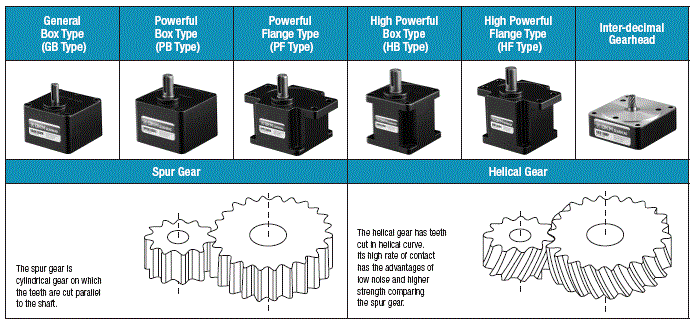
Parallel Gearbox is the most common type in small geared motor.
DKM employs spur type and helical type.
Especially the helical gear is employed for the low-noise and high-strength performance.
Regarding noise the important part in gear is the contacting point with motor shaft which rotating rapidly. DKM employed helical gear which cut high precisely in that point and realized low-noise performance.
2) Worm Gearbox
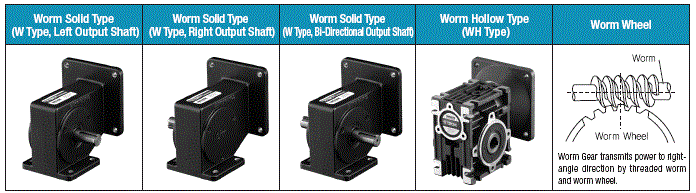
Worm Gearbox has the advantage of using the limited space with high efficiency and realizes the cost saving effect by the reduction of using power transmission part like coupling.
DKM has worm solid type (for up to 120W) and worm hollow type (for 60W-200W).
DKM has worm solid type (for up to 120W) and worm hollow type (for 60W-200W).
4. The Efficiency of Gearbox
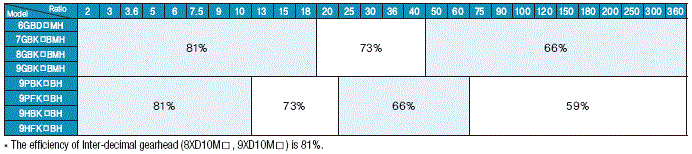
1) The Efficiency of Parallel Gearbox
2) The Efficiency of Worm Gearbox

5. Maximum Permissible Torque
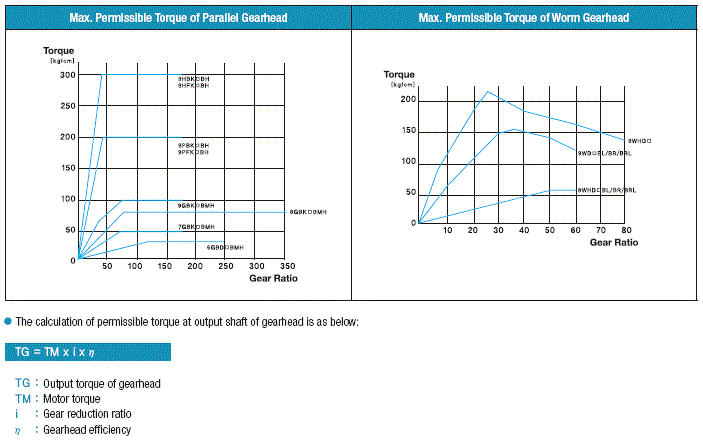
The output torque of gearbox is in proportion to the gear ratio.
But there is limit in the size of load which can be applied to the gearbox in specific gear ratio depending on gear construction and materials etc. affecting the gearhead mechanical strength.
This torque is called the maximum permissible torque.
The maximum permissible torques of typical gearbox are shown in the figure.
6. Gearbox Life Expectancy and Service Factor
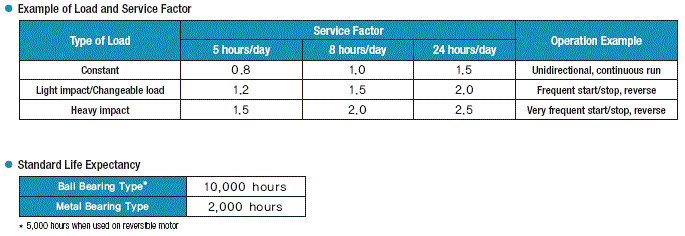
Life expectancy of gearbox varies depending on load fluctuation and is determined by the 'service factor' based on its load. Service factor is a coefficient which is used to estimate the service
life of the gearbox. This value is generally derived from experience and based on type of the load and operating conditions. The standard life can be expected when the product is operated at
service factor 1.0. The life of a component during particular application is estimated by dividing the standard life expectancy by the service factor.
For example, if the motor is operating with an ordinary load for 8 continuous hours a day, the service factor is 1.0. Thus, if the operation continues within the permissible torque for the gearbox and within the range of prescribed temperature (letting the gearbox case temperature stay below 50℃), the life expectancy of the gearbox is 10,000 hours for the ball bearing type and 2,000 hours for the metal type. However, if a ball bearing type of gearbox is operating for 24 hours a day, the service factor becomes 1.5 so that the life expectancy decreases to 1/1.5. Therefore the service factor should be taken into acoount to select such a motor and a gearbox which have biggest permissible torque.
For example, if the motor is operating with an ordinary load for 8 continuous hours a day, the service factor is 1.0. Thus, if the operation continues within the permissible torque for the gearbox and within the range of prescribed temperature (letting the gearbox case temperature stay below 50℃), the life expectancy of the gearbox is 10,000 hours for the ball bearing type and 2,000 hours for the metal type. However, if a ball bearing type of gearbox is operating for 24 hours a day, the service factor becomes 1.5 so that the life expectancy decreases to 1/1.5. Therefore the service factor should be taken into acoount to select such a motor and a gearbox which have biggest permissible torque.
7. Overhung Load and Thrust Load
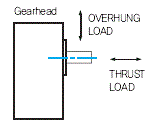
1) The overhung load is defined as a load applied to the output shaft in the right-angle direction. This load is generated when the gearbox is
coupled to the machine using a chain, belt, etc., but not when the gearbox is directly connected to the coupling. The thrust load is defined as a load applied to the output shaft in the axial
direction.
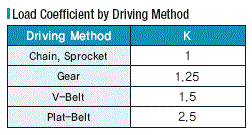
2) Since the overhung load exerts a load directly on the bearing, it affects the life span of the gearbox.
The overhung load can be calculated from the following equation.
The overhung load can be calculated from the following equation.

3) If the motor operates with the calculated overhung load exceeds the maximum allowable value in below table, the output shaft may bend and
the fatigue deformation may occur due to the repeated load. So consider it and take care in sizing.
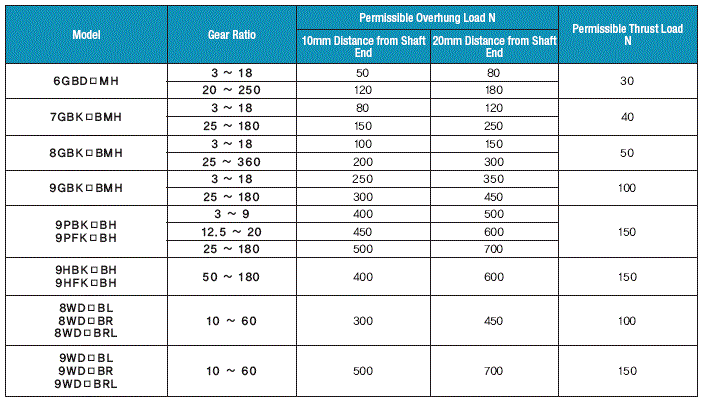
4) In the case of that calculated overhung load value exceeds above allowable value, please set up the structure of the motor as below to
withstand the overhung load.
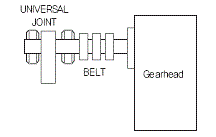
5) Also, if a load should be directly imposed on the output shaft, please place the load as near to the gearbox as possible to avoid the
one-sided load.
6) In the case of that a helical gear or a worm gear is employed as an output delivery mechanism, make sure not to exceed both the overhung
load and the thrust load simultaneously.
8. Backlash Noise of Gearbox
1) Operating Noise of Gearbox
The backlash noise can be indicated by operating noise value.
DKM Gearbox’s operating noise is like below.
DKM Gearbox’s operating noise is like below.
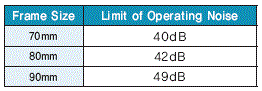
< Reference>
i) Operating noise value is the value measured beside Gearbox with 1m distance.
ii) dB (decibel) is a unit of measurement which is used to indicate how loud a sound is.
iii) Level of operating noise (Ref. value)
20dB --- The sound of a leaf is shaking
30dB --- The sound in suburb of city in night time
40dB --- The sound in a silent park
50dB --- The sound in a silent office
ii) dB (decibel) is a unit of measurement which is used to indicate how loud a sound is.
iii) Level of operating noise (Ref. value)
20dB --- The sound of a leaf is shaking
30dB --- The sound in suburb of city in night time
40dB --- The sound in a silent park
50dB --- The sound in a silent office
2) The check point of Gearbox Noise
(1) Noise in no load
The backlash noise depends on the situation of load. For example, in case of no load rotation, gear could pop and crash between them therefore there could be little vibration and it could cause noise. This noise can be restrained and controlled by carrying some friction load.
The backlash noise depends on the situation of load. For example, in case of no load rotation, gear could pop and crash between them therefore there could be little vibration and it could cause noise. This noise can be restrained and controlled by carrying some friction load.
(2) Noise in Mounting with Load
When mounting is not good in mounting plate, there could be some noise by vibration caused from eccentric force. In this case, please check the mounting situation.
When mounting is not good in mounting plate, there could be some noise by vibration caused from eccentric force. In this case, please check the mounting situation.
(3) Noise of Damaged Gear
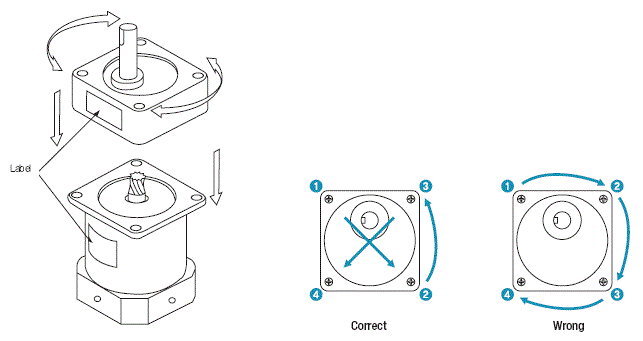
In assembly gearbox and motor, users have to turn the gearbox slowly according to the shape of pinion. Otherwise gear could get damaged. And by over load gear could get damaged. As a result there may some abnormal noise in gearbox. So please handle gearbox with special care in assembly.
In assembly gearbox and motor, users have to turn the gearbox slowly according to the shape of pinion. Otherwise gear could get damaged. And by over load gear could get damaged. As a result there may some abnormal noise in gearbox. So please handle gearbox with special care in assembly.
9. Assembly Method of Motor and Gearbox
To assemble the motor and the gearbox, adjust the assembling faces together in such a way as shown in below figure and turn slowly to complete the assembly. When doing the assembly, special
care should be taken neither to exert excessive force on the motor shaft nor to hit inside of the gearbox. Otherwise, the gear will get damaged, resulting in a abnormal noise and a shortened
lifetime of the motor.
Use the provided mounting screws for set mounting of gearbox and motor, and tighten the screws correctly. Be sure there is no-gab between motor flange, gearbox surface and the mounting surface.
Use the provided mounting screws for set mounting of gearbox and motor, and tighten the screws correctly. Be sure there is no-gab between motor flange, gearbox surface and the mounting surface.